
 English
 Pусский
 한국어
한국어 中文
中文

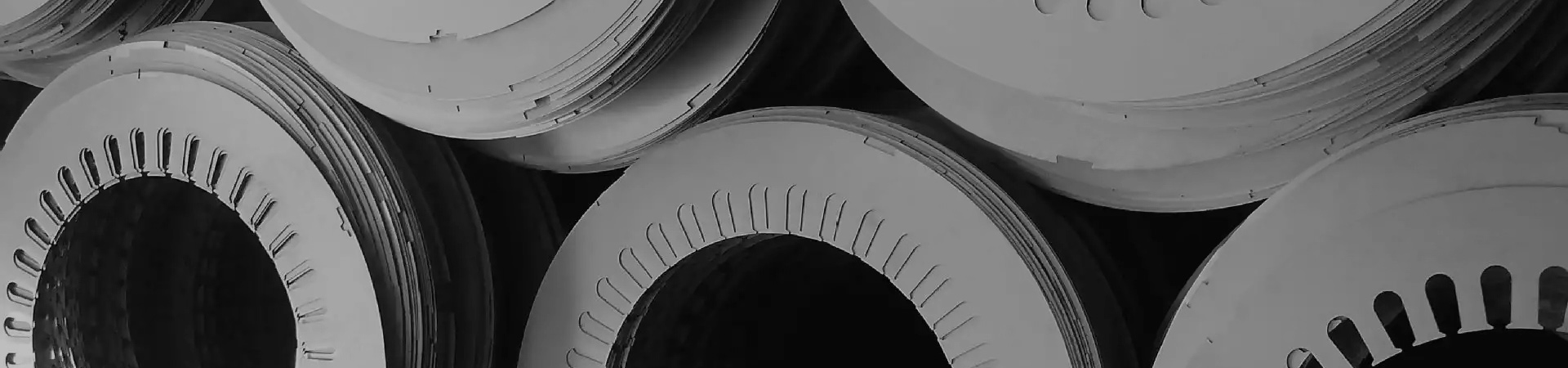
Motor stator and rotor laminations manufacturing
Manufacturing of Motor Stator and Rotor Laminations The production of motor stator and rotor laminations is a critical process in electric motor manufacturing, ensuring high efficiency, reduced energy losses, and optimal magnetic performance. These laminations are typically made from thin electrical steel sheets, which are stacked and bonded to form the core of the stator and rotor. The manufacturing process involves several key steps: material selection, blanking, stacking, and finishing. 1. Material Selection The primary material used for laminations is electrical steel (silicon steel), chosen for its low core loss and high magnetic permeability. The steel is coated with an insulating layer to minimize eddy current losses. The thickness of the laminations typically ranges from 0.1 mm to 0.65 mm, depending on the motor’s power and frequency requirements. 2. Blanking (Punching or Laser Cutting) The electrical steel sheets are cut into the desired shapes using either mechanical punching or laser cutting. Punching is a high-speed, cost-effective method suitable for mass production, while laser cutting offers greater precision for complex geometries. The blanking process produces individual laminations with slots, teeth, and other features required for winding and assembly. 3. Stacking and Bonding After blanking, the laminations are stacked to form the stator or rotor core. Proper alignment is crucial to maintain consistent magnetic properties. The stack is secured using various methods: - Interlocking: Small tabs are bent to hold laminations together. - Welding or Riveting: Provides mechanical strength but may increase eddy currents. - Adhesive Bonding: A non-conductive adhesive is applied between layers to minimize losses. 4. Heat Treatment (Optional) Some laminations undergo stress-relief annealing to improve magnetic performance by removing internal stresses caused during blanking. 5. Finishing Processes - Insulation Coating: Additional insulation may be applied to further reduce eddy currents. - Machining: Critical surfaces may be ground or machined for precise fitment. - Quality Inspection: Dimensional checks, stacking factor verification, and magnetic property testing ensure compliance with specifications. Key Considerations - Core Loss Minimization: Thin laminations and high-quality electrical steel reduce hysteresis and eddy current losses. - Precision and Consistency: Tight tolerances are maintained to ensure proper motor performance. - Automation: Advanced manufacturing lines use automated stacking and bonding for efficiency. By optimizing these processes, manufacturers produce high-performance stator and rotor laminations that enhance motor efficiency, reduce energy consumption, and extend operational life.
Sản phẩm
Danh mục:
Phim đấm và số lượng lớn
Không có kết quả tìm kiếm!
Tin tức
Danh mục:
Không có kết quả tìm kiếm!
Trường hợp
Danh mục:
Không có kết quả tìm kiếm!
Video
Danh mục:
Không có kết quả tìm kiếm!
Tải về
Danh mục:
Không có kết quả tìm kiếm!
Tuyển dụng
Danh mục:
Không có kết quả tìm kiếm!
Sản phẩm được đề xuất
Không có kết quả tìm kiếm!
 Di động: +86 13738592999
 Điện thoại: +86(576) 89307999
 Email: sales@zjxinzheng.com
 Địa chỉ: Thành phố công nghiệp ven biển, Sanmen



 Whatsapp
 Điện thoại