
 English
 Pусский
 한국어
한국어 中文
中文

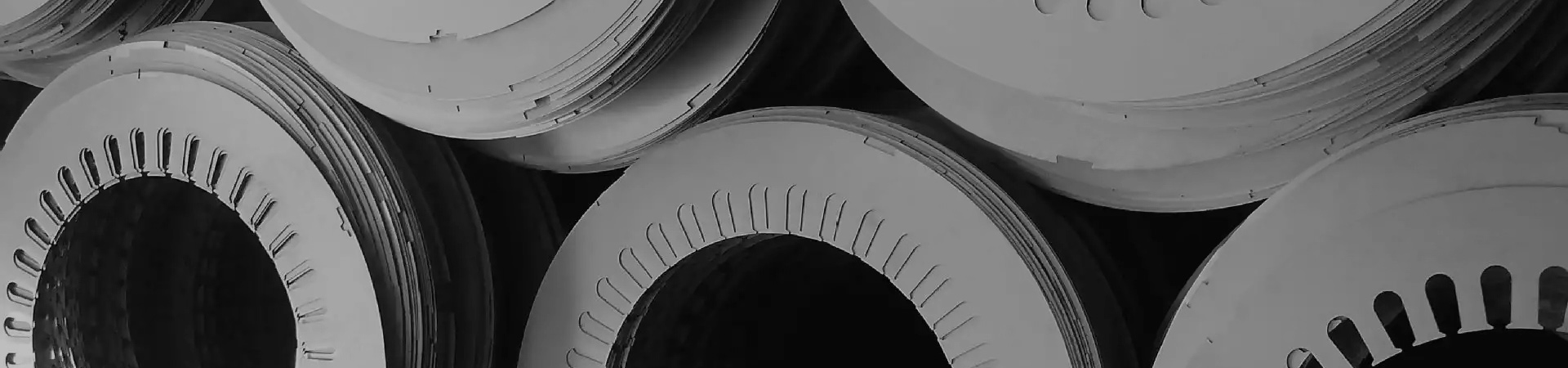
lõi cán động cơ
Motor Lamination Core: Design, Function, and Manufacturing The motor lamination core is a critical component in electric motors and generators, serving as the foundation for electromagnetic energy conversion. It consists of thin, stacked steel laminations that form the stator and rotor cores, ensuring efficient magnetic flux conduction while minimizing energy losses. Design and Function The primary role of the lamination core is to provide a low-reluctance path for magnetic flux, enabling smooth rotation in motors or power generation in alternators. The core is typically made from electrical steel (silicon steel) due to its high magnetic permeability and low hysteresis losses. The laminations are insulated from each other (often with a coating or oxide layer) to reduce eddy current losses, which occur when alternating magnetic fields induce circulating currents in conductive materials. Key design considerations include: - Material Selection: Grain-oriented or non-oriented silicon steel is chosen based on application requirements (e.g., high efficiency or cost-effectiveness). - Thickness: Laminations range from 0.1 mm to 0.5 mm; thinner sheets reduce eddy currents but increase manufacturing complexity. - Shape and Slotting: Precision-cut slots accommodate windings and ensure optimal magnetic flux distribution. Manufacturing Process 1. Material Preparation: Electrical steel coils are unrolled and cleaned to remove impurities. 2. Punching/Stamping: Laminations are stamped into precise shapes using progressive dies or laser cutting for high accuracy. 3. Coating/Insulation: A thin insulating layer (e.g., phosphate or varnish) is applied to minimize interlamination conductivity. 4. Stacking and Bonding: Laminations are stacked and secured via welding, riveting, or adhesive bonding to form a rigid core. 5. Heat Treatment (Optional): Annealing may be used to relieve stress and enhance magnetic properties. Performance and Efficiency Lamination cores directly impact motor efficiency, torque, and thermal performance. Poorly designed cores lead to excessive heat generation, noise, and energy waste. Advanced techniques like segmented or hybrid cores further optimize performance in high-speed or high-frequency applications. Applications Lamination cores are used in: - AC/DC motors (industrial, automotive, appliances) - Generators and alternators - Transformers and actuators Conclusion The motor lamination core is a meticulously engineered component that balances material science, precision manufacturing, and electromagnetic principles. Its design directly influences motor efficiency, reliability, and lifespan, making it indispensable in modern electromechanical systems. (Word count: 500)
Sản phẩm
Danh mục:
Không có kết quả tìm kiếm!
Tin tức
Danh mục:
-
[FAQ]Vai trò của cán màng động cơ trong hiệu suất động cơ điện
2025-10-07 16:02:01 -
[Company News]Lớp phủ cán động cơ để tăng cường độ bền
2025-10-08 08:55:16
Trường hợp
Danh mục:
Không có kết quả tìm kiếm!
Video
Danh mục:
Không có kết quả tìm kiếm!
Tải về
Danh mục:
Không có kết quả tìm kiếm!
Tuyển dụng
Danh mục:
Không có kết quả tìm kiếm!
Sản phẩm được đề xuất
Không có kết quả tìm kiếm!
 Di động: +86 13738592999
 Điện thoại: +86(576) 89307999
 Email: sales@zjxinzheng.com
 Địa chỉ: Thành phố công nghiệp ven biển, Sanmen



 Whatsapp
 Điện thoại