
 English
 Pусский
 한국어
한국어 中文
中文

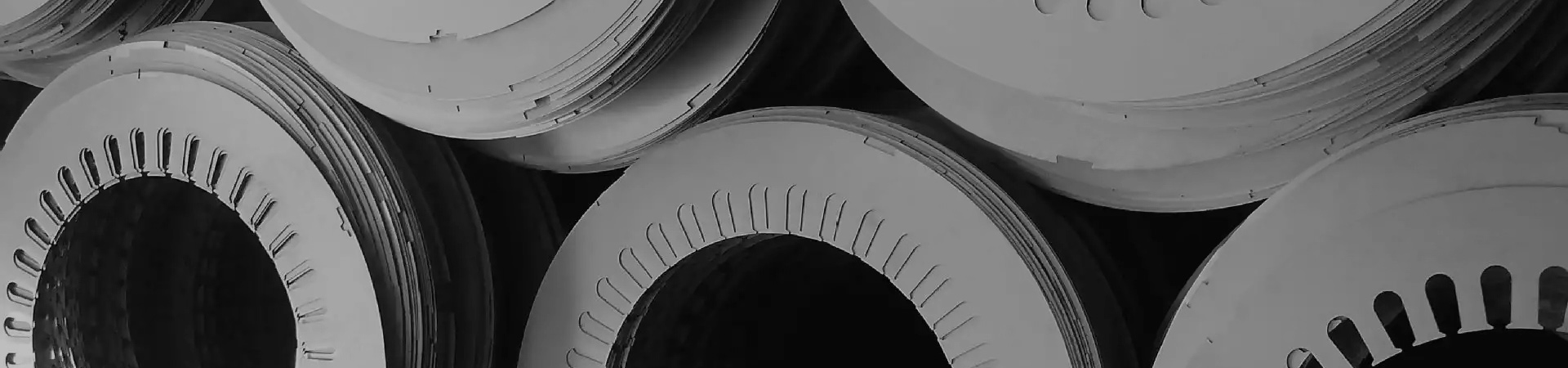
cán lõi động cơ
Motor Core Lamination: Design, Materials, and Manufacturing Motor core lamination is a critical component in electric motors and generators, serving as the magnetic core that facilitates efficient energy conversion. The laminated structure minimizes energy losses, improves performance, and enhances thermal management. Below is a detailed overview of its design, materials, and manufacturing processes. Design and Function The motor core consists of thin, stacked steel sheets (laminations) that form the stator and rotor. Laminations are used instead of solid cores to reduce eddy current losses, which occur when alternating magnetic fields induce circulating currents in conductive materials. By insulating individual layers, the core limits these losses, improving efficiency and reducing heat generation. Key design considerations include: - Thickness: Laminations typically range from 0.1mm to 0.5mm, with thinner sheets offering lower eddy current losses. - Shape: Laminations are stamped or laser-cut into precise geometries, including slots for windings and ventilation channels. - Stacking: Multiple laminations are bonded or welded to form a rigid core structure. Materials The most common material for motor laminations is electrical steel (silicon steel), which offers high magnetic permeability and low hysteresis losses. Variants include: - Non-Oriented Silicon Steel: Used in applications requiring isotropic magnetic properties. - Grain-Oriented Silicon Steel: Provides superior magnetic performance in one direction, often used in transformers. Coatings such as phosphates or oxides are applied to laminations to enhance electrical insulation and corrosion resistance. Manufacturing Processes 1. Stamping/Laser Cutting: Laminations are produced by stamping (for high-volume production) or laser cutting (for precision and flexibility). 2. Annealing: Heat treatment relieves internal stresses and improves magnetic properties. 3. Coating/Insulation: Insulating layers are applied to minimize interlamination conductivity. 4. Stacking and Bonding: Laminations are stacked and secured using adhesives, welding, or interlocking features. 5. Final Assembly: The core is integrated with windings, housings, and other motor components. Advantages of Laminated Cores - Reduced Energy Losses: Minimizes eddy currents and hysteresis losses. - Improved Efficiency: Enhances motor performance and thermal management. - Lightweight Construction: Enables compact and efficient motor designs. Applications Laminated cores are used in various motors, including: - AC/DC Motors - Servo Motors - Generators and Transformers Conclusion Motor core lamination is essential for modern electric machines, balancing efficiency, cost, and performance. Advances in materials and manufacturing continue to drive improvements in motor design, supporting applications in automotive, industrial, and renewable energy sectors. (Word count: 500)
Sản phẩm
Danh mục:
Không có kết quả tìm kiếm!
Tin tức
Danh mục:
-
[Company News]Quy trình sản xuất lõi động cơ từng bước
2025-10-07 16:21:25 -
[FAQ]Sự thay đổi nhiệt độ ảnh hưởng đến hiệu suất lõi động cơ như...
2025-10-08 08:57:04
Trường hợp
Danh mục:
Không có kết quả tìm kiếm!
Video
Danh mục:
Không có kết quả tìm kiếm!
Tải về
Danh mục:
Không có kết quả tìm kiếm!
Tuyển dụng
Danh mục:
Không có kết quả tìm kiếm!
Sản phẩm được đề xuất
Không có kết quả tìm kiếm!
 Di động: +86 13738592999
 Điện thoại: +86(576) 89307999
 Email: sales@zjxinzheng.com
 Địa chỉ: Thành phố công nghiệp ven biển, Sanmen



 Whatsapp
 Điện thoại